The Founding
1962 — How Germany got its league
Germany in the summer of 1962. Since 1949, Konrad Adenauer has been governing the Federal Republic of Germany, which speaks less about the Second World War than about economic boom and the Wirtschaftswunder. In the GDR, Walter Ulbricht still heads the SED. The consequences of the Second World War are still omnipresent, and anyone opening the newspapers on July 28 learns that Brazil's government has banned the printing of the third edition of Hitler's "Mein Kampf" on this very day. And he reads about five arrested wall attackers in West Berlin. The young men wanted to blow up the wall that divides the city into East and West, because "we are against the wall." Not unusual, just unusually brave.
Nevertheless — the signs point to change. Konrad Adenauer will lead the Federal Republic for just over another year (before being replaced by Ludwig Erhard), Walter Ulbricht's days are also numbered (he just doesn't know it yet). And something fundamental is about to change in German football too. At least in West German football. On that Saturday, football officials and delegates in Dortmund want to tear down old football walls.
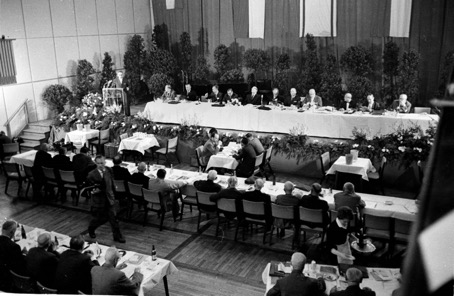
And they are in good spirits. The weekend has started pleasantly for the (predominantly older) men who want to make an epochal decision. On the evening before the 14th DFB Congress, most have already gathered at the Dortmund Congress Center Westfalenhallen on Rheinlanddamm, right on the B1, and enjoyed an entertaining preliminary program in the so-called Goldsaal.
At 2:45 PM, the delegates have fortified themselves culinarily to tackle the founding of the Bundesliga. The DFB executive committee makes no secret of which outcome it desires. After all, it has itself submitted the motion to found the Bundesliga.
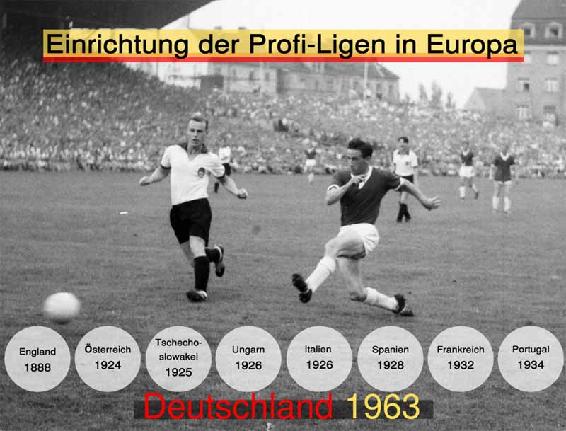
The decision had its opponents. And its supporters. The German Football Association (DFB) had been discussing the introduction of a professional league for years. The existing system of five regional Oberligen was outdated — West Germany was the only major football nation without a unified top division.
DFB President Peco Bauwens and later his successor Hermann Gösmann pushed for reform. The key argument: international competitiveness. While clubs from Spain, Italy and England dominated European competitions, German clubs fell behind, partly because their best players were lured abroad by professional contracts.
The vote passes. 103 to 26 delegates vote in favor of the Bundesliga. The first season is set for 1963/64. Now the question becomes: who gets in?
46 clubs apply for admission to the Bundesliga, evaluated through a so-called twelve-year rating system plus additional regional criteria. On January 11, 1963, the sixteen founding members are announced: 1. FC Köln, Meidericher SV, Borussia Dortmund, FC Schalke 04, 1. FC Nürnberg, Hamburger SV, Eintracht Frankfurt, Werder Bremen, TSV 1860 München, VfB Stuttgart, Hertha BSC, Karlsruher SC, Preußen Münster, FC Kaiserslautern, Eintracht Braunschweig, and FC Saarbrücken.
Incidentally: a centralized football league had already existed in the GDR since 1949 — first as the East Zone League, then from November 1949 under the name DS-Liga, and from 1950 as the DDR-Oberliga.