First Decade
1963–1972: The early years, Gerd Müller and the Bundesliga scandal
When it is finally accomplished in the summer of 1963, Deutsche Bahn runs a special train on every matchday, and football in Germany has changed forever. On August 24, 1963, referee Hans Kadelbach blows the whistle for the very first Bundesliga match: Werder Bremen versus Borussia Dortmund. Dortmund's Timo Konietzka scores the first goal after just 58 seconds — a record that would stand for decades.
The first champion is 1. FC Köln. The first star is Gerd Müller, "Der Bomber der Nation," who arrives at Bayern Munich in 1964 as a stocky young man from Nördlingen and proceeds to rewrite every goalscoring record. His 40 goals in the 1971/72 season remain a Bundesliga record that seems untouchable. In total, Müller scores 365 goals in 427 Bundesliga appearances — an average that defies comprehension.
The early years are wild and unpredictable. Five different clubs win the title in the first five seasons. Eintracht Braunschweig becomes champion in 1967, 1. FC Nürnberg in 1968 — clubs that would never again reach such heights. Borussia Mönchengladbach emerges as a force under coach Hennes Weisweiler, winning back-to-back titles in 1970 and 1971 with the legendary "Foals" — Günter Netzer, Berti Vogts, Jupp Heynckes.
But the first decade ends in scandal. The Bundesliga match-fixing affair of 1971 reveals that players from several clubs, including Hertha BSC, Arminia Bielefeld, Schalke 04 and others, have accepted money to fix results. The scandal rocks German football to its core. Players are banned, clubs are fined, and the Bundesliga's reputation takes its first major hit. It wouldn't be the last.
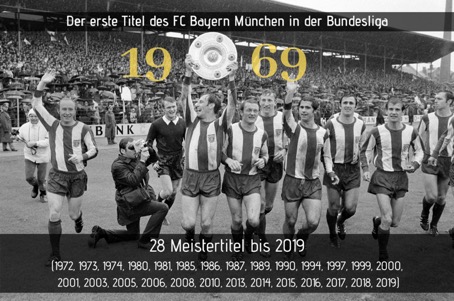
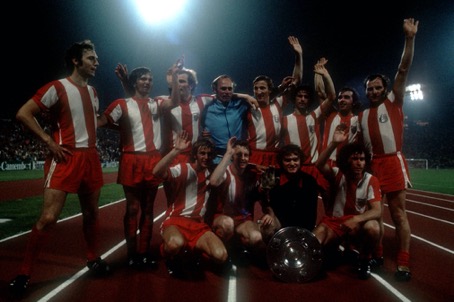
Bayern Munich finishes the decade as the rising power — champions in 1969 and 1972, with Gerd Müller, Franz Beckenbauer and Sepp Maier forming the nucleus of what would become the most dominant club in German football history.